
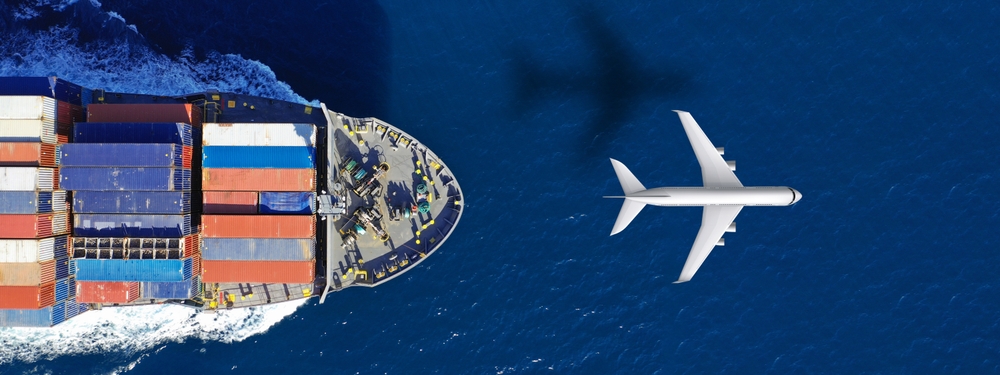
When shipping goods internationally, choosing the right transportation method can significantly impact your delivery timeline, shipping costs, and overall supply chain efficiency.
Two of the most common options are air freight and ocean freight. While both transport goods across international borders, they offer different advantages depending on your shipment’s size, value, and urgency.
Ocean freight is often preferred for larger shipments because it’s cost-effective, while air freight offers a faster alternative for time-sensitive cargo.
At Krenz & Hannan International, we coordinate international air and ocean transportation for businesses of all sizes. Understanding when to use each method can help you make informed shipping decisions and avoid unnecessary expenses.
What Is the Difference Between Air Freight and Ocean Freight?
The biggest differences between air freight and ocean freight are transportation speed, cost, and cargo capacity.
Air freight involves transporting goods by aircraft. It is generally the fastest option for international shipments, making it valuable when delivery deadlines are tight.
Ocean freight involves transporting goods aboard cargo vessels. Although transit times are typically longer, ocean shipping is often more economical for large, heavy, or high-volume shipments.
Ocean freight also offers flexible container options, including Full Container Load (FCL) and Less than Container Load (LCL) shipping.
Neither method is automatically better. The right choice depends on your shipment’s requirements and business priorities.
1. When Your Shipment Is Time-Sensitive
One of the strongest reasons to choose air freight is speed.
Ocean shipments can take several weeks depending on the origin, destination, shipping route, and port conditions. Air freight generally moves cargo internationally much faster.
For businesses facing urgent deadlines, that difference can be significant.
Air freight may be particularly valuable for:
- Emergency inventory replenishment
- Time-sensitive product launches
- Replacement machinery parts
- Medical equipment and supplies
- Products needed to prevent production delays
For example, imagine a manufacturer waiting for a replacement component needed to restart production.
Choosing ocean freight might save money on transportation, but the cost of keeping production equipment idle could far exceed those savings.
In situations like this, paying more for air freight may be the more economical business decision.
2. When You Are Shipping High-Value Products
The value of your cargo is another important consideration.
Air freight is commonly used for high-value products because shipments typically spend less time in transit and move through controlled airport cargo facilities.
Products frequently transported by air include electronics, specialized equipment, luxury goods, and sensitive components.
Although air transportation does not eliminate the risk of damage, theft, or delays, shorter transit times and established security procedures may benefit certain shipments.
When deciding whether air freight is worthwhile, consider the value of the merchandise and the potential financial consequences of a delayed delivery.
For expensive or business-critical products, faster transportation may justify the additional cost.
3. When Your Shipment Is Small or Lightweight
Air freight is not always reserved for large corporations or emergency shipments.
It can also be practical for smaller quantities of merchandise, particularly when the cargo is lightweight, compact, or valuable.
For example, a company importing product samples or prototypes may not want to wait several weeks for ocean transportation.
Air freight allows businesses to receive smaller shipments quickly, making it easier to evaluate products, test new markets, or meet customer requests.
However, air freight pricing often considers both actual weight and dimensional weight, which reflects the space a shipment occupies.
Bulky but lightweight products can therefore be expensive to transport by air.
Comparing quotes based on your shipment’s actual dimensions and weight is essential.
4. When Inventory Delays Could Cost More Than Shipping
The lowest freight rate does not always mean the lowest overall cost.
Imagine a retailer preparing for an important seasonal sales period. If inventory arrives after the peak shopping window, the business could lose valuable sales opportunities.
Similarly, a manufacturer waiting for critical materials may face production interruptions if cargo does not arrive on schedule.
In these situations, the additional cost of air freight may be outweighed by the financial impact of delayed inventory.
Businesses should consider the complete cost of transportation, including potential lost revenue, production downtime, and customer commitments.
A freight forwarder can evaluate available transportation options and help determine whether faster shipping is worth the investment.
5. When Predictable Delivery Timing Matters
International shipping schedules can be affected by weather, congestion, equipment availability, and other disruptions.
Ocean freight may experience delays related to port congestion, vessel scheduling, or changes in shipping routes.
Air freight generally offers shorter transit times and more frequent departures on many major international routes.
This can be valuable for businesses managing tight inventory schedules or coordinating deliveries with specific production deadlines.
However, air freight is not immune to delays. Flight cancellations, cargo capacity restrictions, customs examinations, and severe weather can still affect delivery schedules.
The best approach is to evaluate the complete transportation timeline, including pickup, airport handling, customs clearance, and final delivery.
When Does Ocean Freight Make More Sense?
Although air freight offers important advantages, ocean freight remains a practical and cost-effective solution for many international shipments.
Ocean transportation is often the better choice when:
- Shipping large quantities of merchandise
- Transporting heavy or oversized products
- Moving goods that are not urgently needed
- Maintaining predictable inventory replenishment schedules
- Prioritizing lower transportation costs
For businesses importing substantial quantities of products, ocean freight can provide significant cost advantages.
Full Container Load shipping lets businesses reserve an entire container, while Less than Container Load shipping offers flexibility for smaller shipments that can share container space.
Ocean freight also generally produces lower greenhouse gas emissions per ton-mile than air transportation, making it worth considering for businesses with sustainability goals.
Can Businesses Use Both Air and Ocean Freight?
Yes. In fact, combining both transportation methods can be an effective supply chain strategy.
For example, a company launching a new product might ship a smaller initial quantity by air to meet its launch deadline.
The remaining inventory could travel by ocean freight to reduce overall transportation expenses.
This approach allows businesses to balance speed and cost without relying exclusively on one shipping method.
A flexible transportation strategy can also be valuable when unexpected demand, inventory shortages, or supply chain disruptions occur.
How Krenz & Hannan International Can Help
Choosing between air and ocean freight requires more than comparing transportation rates.
Businesses should consider cargo dimensions, shipment value, delivery deadlines, customs requirements, and the total cost of moving goods from origin to destination.
At Krenz & Hannan International, we coordinate international freight transportation and customs brokerage services to help businesses make informed shipping decisions.
As a TSA-approved Indirect Air Carrier and a Federal Maritime Commission-licensed Ocean Transportation Intermediary, Krenz & Hannan provides professional transportation solutions for a variety of international shipping needs.
Our team works with customers to evaluate shipping options, coordinate carriers, prepare documentation, and manage transportation arrangements.
Whether your priority is faster delivery or economical movement of larger shipments, we can help identify an approach that fits your business.
Find the Right Shipping Solution for Your Business
Air freight and ocean freight both play important roles in international trade.
If speed, urgency, or cargo value is your primary concern, air freight may be the right choice. If you are moving larger quantities and have more flexibility in your delivery timeline, ocean freight may provide better value.
The key is choosing the transportation method that supports your business goals, not focusing on shipping costs alone.
At Krenz & Hannan International, we provide customized international freight forwarding solutions designed around your transportation needs.
Ready to plan your next international shipment? Contact Krenz & Hannan International today to explore our Air Freight and Ocean Freight services and request a customized shipping quote.